
AI in project and construction management: definition, real scope and current uses
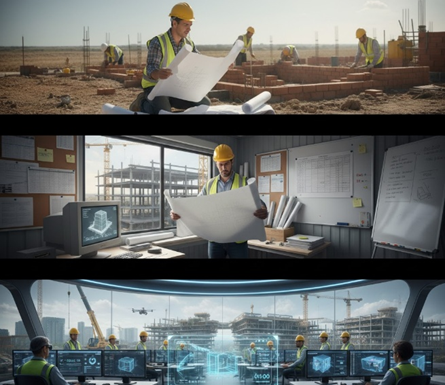
In almost all industries, it is normal to talk about Business Intelligence, prediction, automation, or ERP… Nobody in the automotive or aeronautical sectors discusses whether to design in 2D or 3D or if it should be ERP or Excel. In construction, however, we still debate whether BIM or no BIM, notebook or tablet, and things like automation, BI or taking a LiDAR scanner to the site still seem like science fiction. The same thing happens with AI: there are expectations, but limited adoption.
Where do we start?
The sector is complex, yes, but that does not invalidate techniques that already work elsewhere. I like to explain AI-driven construction project management with the analogy of a journey from A (the idea) to B (the completed work). How do you make your journeys?:
On foot, with a paper map and no instruments? By car with a map, but no indicators or Google Maps? By car with all the indicators and navigation? The difference is not just the vehicle, it is the instruments and the discipline of use.

Therefore, applied AI has many branches, but the one that interests us most in the field of management is one: AI Agents.
What are AI agents?
In 2025 everyone is talking about “AI agents.” Let’s translate this without the hype: an agent is an AI-driven system that, in addition to understanding natural language, can use tools, plan steps, and execute actions with permissions and traceability. It is useful when tasks need to be chained, decisions justified, and nothing broken along the way.
Before, three ideas not to be disappointed
- This is about data: AI is, to a large extent, advanced data processing. Without organized sources, it will fail.
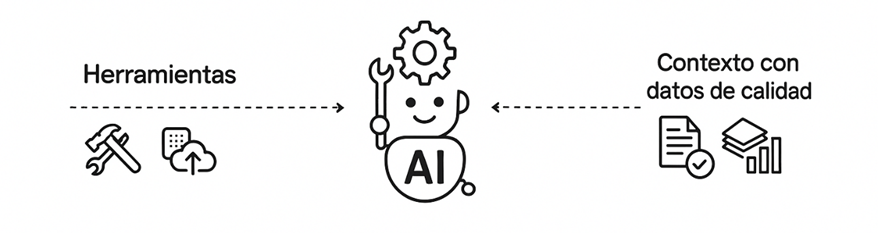
- Base models with biases: GPT, Gemini, and the others hallucinate if you don’t give them quality context.
- AI ≠ agent: AI “answers”, the agent also acts with tools and plans what to do next.
What capabilities do AI agents have?
1- Perceive
What it implies: ingesting heterogeneous information and understanding its minimum structure.
Typical sources: documents, emails, schedules, incidents, repositories, BIM, databases, internal web, APIs. AEC
Examples: reading a PDF tender document and the Primavera schedule, extracting changes from an email thread, consulting an IFC model and a BC3.
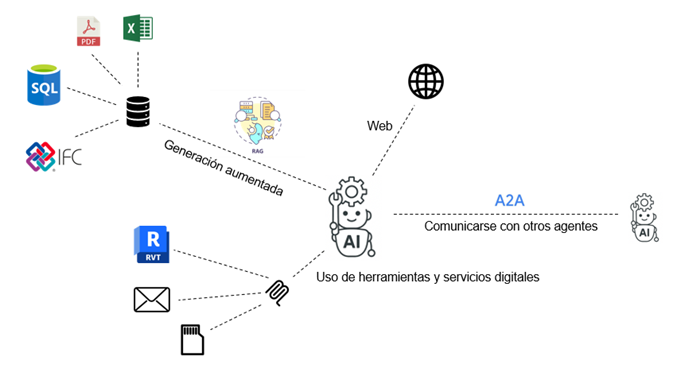
2- Process and plan
What it involves: interpreting text/tables/images, breaking down the task into steps, replanning based on intermediate results.
How it is done: LLM + rules/validators + specialized prompts or subagents.
AEC Examples: normalizing bids, detecting inconsistencies between planning and measurements, preparing an agenda with critical points.
3- Act
What it involves: executing actions in systems with minimum permissions and traceability.
Typical Actions: generating drafts, launching SQL/GraphQL queries, completing fields in forms, invoking corporate APIs, opening tickets.
AEC Examples: creating the draft of a meeting minute with agreements and responsible parties, updating the status of an item in the CDE (Common Data Environment), issuing an inquiry to suppliers.
4- Learn and adjust
What it involves: improving with controlled memory, finetuning and internal knowledge (RAG), and autocorrecting before delivery.
Mechanisms: project memory, lessons learned, automatic checklists, output benchmarks, and finetuning.
AEC Examples: maintaining terminology for each client, recalling contract exceptions, applying the quality checklist before publishing a report, improving results in each iteration.
Minimum conditions for it to work
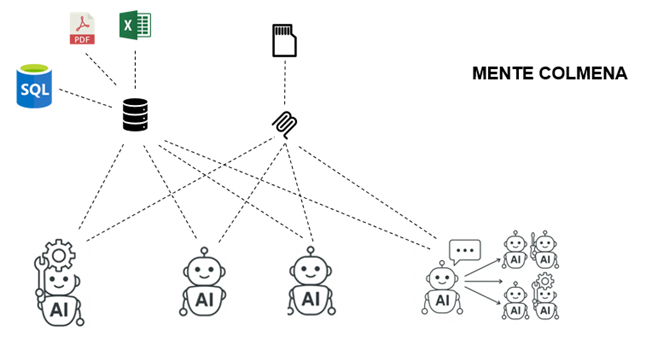
- Accessible, quality, and governed data (versioning, metadata, sources of truth, ETL).
- Permissions and segregation by role and environment; no “open bar” credentials.
- Complete traceability of decisions and actions.
- Human review before publishing or deciding.
A well-trained AI with good tools can indeed be a disruptive element.
Summary AI will be as good as the data it sees; an agent connects that AI with your tools and processes to execute controlled steps. With good context and good rules, it can indeed be a differentiating factor.
A well-trained AI with good tools can indeed be a disruptive element.
Where it hurts in AEC (Architecture, Engineering, and Construction) and is also a data problem where AI and agents can make a difference
- Compliance check Dispersed
rules and articles, versions, and exceptions. You need a normalized corpus, traces, and validators. - Site Planning
plans, restrictions and progress in silos. It is necessary to consolidate sources, detect inconsistencies, and replan with evidence. - Objective Procurement (beyond price)
Photos, 360, scanner, reports, and models without a “source of truth.” Integration, labeling, and certification rules. - Progress Monitoring
Fotos, 360, escáner, partes y modelos sin un “fuente de verdad”. Integración, etiquetado y reglas de certificación. - Risk Management and Prediction
Repeated incidents without actionable lessons. Cataloging, features by typology, and early warning signs. - Labor Shortage
Expensive people doing repetitive tasks. Standardize inputs and automate mechanical work to free up capacity. - Profitability
Rework, waiting, and omissions. Measure times, rejections, and variability to stop leaks.
How can it be used in project and construction management?
Reasoning agents are not only useful for repetitive tasks. They add value when it is necessary to combine several sources, maintain context between steps, justify decisions with references, and chain actions with permissions and traceability.
What they offer today compared to classic automation
- Multi-step planning: They break down a request into subtasks and execute them in logical order, reattempting if something fails.
- Verification and self-correction: They check their own output against rules or samples before delivering it.
- Project memory: They maintain stable context (terminology, agreements, exceptions) between sessions.
- Controlled use of tools: They call APIs and update systems with permissions and complete traceability.
Typical use cases and their impact
- Agents for assistance in ordinary tasks: Reviewing documents and contrasting them with others, answering questions by citing sources, managing calendar and meetings, taking notes, and preparing draft meeting minutes.
Impact: going from 45min to 10–15 min per preliminary minute, weekly savings of 1.5–2.5 hours per manager depending on the number of meetings. - Agents for information analysis and synthesis: Analyzing and processing project or company data to extract patterns, tracing events that explain incidents, comparing proposals and budgets, and auditing documents.
Impact: the initial normalization and screening phase drops from 1 day to 2–4 hours, maintaining subsequent team review76. - Documentation generation: Drafts of technical reports, minutes, monitoring reports, and technical annexes from heterogeneous inputs.
Impact: 30–50% reduction in first draft time, final quality depends on the degree of review and the order of the sources. - BIM information audits for construction certifications: Verification of completeness and consistency of key fields in BIM models used for certification.
Impact: More accurate certifications, reduction of uncertainty, economic and time savings. - Supplier comparison with historical data: Normalization of bids, detection of atypical prices and recovery of registered precedents.
Impact: preliminary structured comparison in 2–4 hours instead of 1–2 days, maintaining human decision. - Agents for recurring risk management: Signaling conflicting materials or solutions according to past incidents and organizational context, with documented suggestions.
Impact: decrease in recurrence and better preparation of technical questions to suppliers. - Agent for monitoring agreements in minutes: Identification of untackled points, tracing of events and reminders. Traceability of decisions and actions for contract penalties.
Impact: lower rate of commitments lost between meetings and better traceability.
Conclusion
AI agents already add value in documentary and repetitive processes with accessible data, clear rules, and supervision.
Consistent gains: less preparation time, more homogeneous first versions, and fewer silly omissions. It is not “automating everything”, it is eliminating mechanical work where a pattern and decent data already exist. If your data is a chaos, the agent will only document the chaos faster.
At AECOTECH, we help you have the necessary systems to achieve greater profitability in your projects and reduce your risks.


