
BIM en el mundo
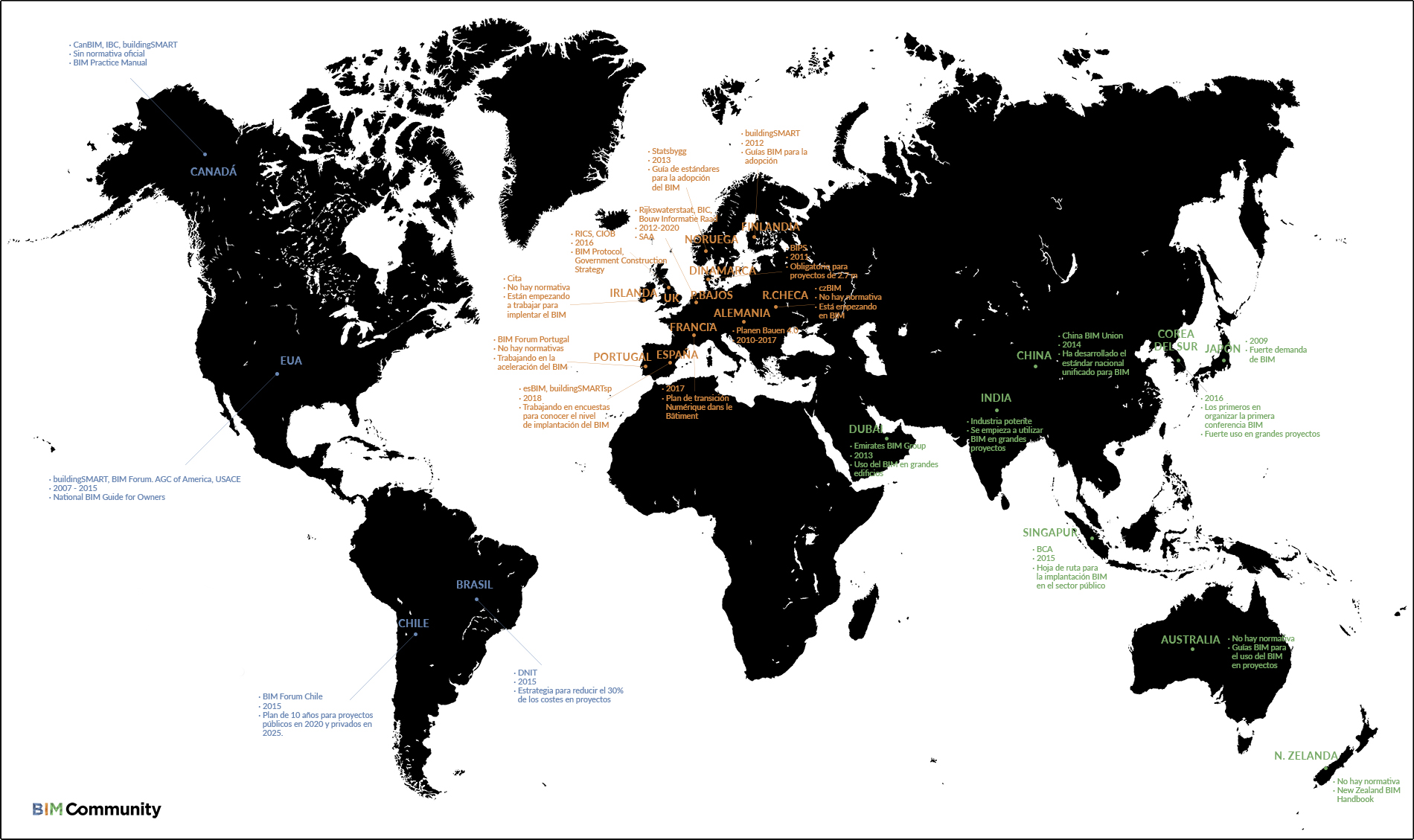
A review of the current status of BIM around the world, taking as a reference those countries that are most advanced in implementing this new methodology.
BICP (BIM Innovation Capability Programme) is the organization responsible for the Construction 2020 report in Ireland, where Enterprise Ireland promotes the use of BIM in various organizations , thereby developing the skills necessary to meet the challenges it poses. There are four types of packages that allow for the strategic objectives imposed by the BICP to be met. These include, among other things, a systematic review of BIM adoption in international regions, with a particular emphasis on support for the implementation of new programs.
The study focuses on exploring the value proposition underlying these types of initiatives, which both governments and professionals are undertaking to implement BIM in their countries of origin. To this end, an analysis of several regions was conducted, taking Europe as the main starting point. Specifically, and from this European perspective, a number of countries have already initiated programs to promote the use of BIM. A clear example is the case of the European Commission, which has awarded the work of the EU Task Group , founded with the aim of creating a common European network aimed at aligning the use of BIM in public works.
Looking to Europe: The main bastion of BIM Level 2 use in the United Kingdom (where most agents work with their own 3D CAD models and not necessarily a single, shared model), it has been mandatory since the beginning of this year. The English government’s first value proposition is to align this initiative with a controlled reduction in costs , project delivery times, and carbon use. BIM has already been implemented in several initiatives, including Cell 180 at the Ministry of Justice’s Cookham Wood prison, where savings of over £800,000 were achieved. Scotland, for its part, launched a Level 2 implementation program in 2015, stipulating that it will be mandatory by April 2017 for projects within the £4 million threshold. The Scottish Futures Trust has already launched the BIM Level 2 Grading Tool , which helps understand how to adopt these standards, and the BIM Compass , which assesses BIM capabilities and compares them with key industry benchmarks.
The French government plans to officially adopt BIM in more than 500,000 homes by 2017 , with the Plan Transition Numérique dans le Bâtiment group leading the roadmap. In Germany, the number of highly qualified profiles has grown significantly, leading the creation of Planen Bauen 4.0 , an independent company that will lead the implementation of BIM for the 2020 mandate. Italy, meanwhile, plans to implement BIM for public works budgets above €5 million , effective from October 2016. However, this new methodology has already been used for a large number of projects to date, including the Milan Opera House and the expansion of Rome Fiumicino Airport. Spain has also established the mandatory use of BIM by March 2018 , while infrastructure projects will have to wait until 2019. The BIM Methodology Implementation Committee was created to establish BIM parameters in the national construction sector.
Scandinavian countries have been leading proponents of the BIM agenda for years and have already experienced the improvements firsthand. In Finland , the Finnish Construction Confederation decided that BIM would be a key element in all changes to be made in the sector in 2012. Within government institutions, its use has been mandatory since 2007 for all design software that wishes to pass the IFC certification in accordance with the requirements established by the BIM mandate. In Denmark, BIM has also been in place for several years since the Danish Parliament extended the mandate for BIM adoption to all local and regional projects above 2.7 million in June 2011, while for central projects the threshold is set at 677,000. Meanwhile, the Norwegian government established its own national mandate to reduce errors, improve coordination, increase the energy efficiency of all its buildings, and become more competent in general. This is a joint declaration outlining the specific requirements for each participating project to adopt open standards by July 2016. It has been signed by a wide range of public sector clients, including the Norwegian Defence Estates.
The Netherlands established the BIC (Building Information Council) as part of the Rijkswaterstaat BIM programme on roads and canals, thus improving the quality, continuity and international competitiveness of the construction industry in 2012. In 2015 the Royal Institute of Dutch Architects stated that over 76% of practices in the Netherlands were carried out with BIM benefits . For example, the country’s largest road reconstruction programme, SAA (Schiphol-Amsterdam-Almere) was entirely carried out using this new methodology and had a budget of 4 billion euros, to be managed between 2012 and 2020. The Czech Republic has only just started using new technologies and developing a new information model , but in most areas of the construction process the 2D model is still preferred. The 2016 NBS International Report stated, based on its findings within the Czech Republic, that almost all of the 157 respondents were aware of BIM, but only 13% actually used it.
In Switzerland, there is an Open BIM guide that helps users develop a BIM methodology in collaboration with standards and regulations from the Swiss Society of Engineers and Architects. This can be very useful for the nearly 91% of respondents to the BIM report published by the Genoa University of Technology, who plan to use it within a three-month period. The Spitalverband Limmattal hospital group has already selected a subsidiary of Bouygues Construction Switzerland to deliver a €175 million hospital project using BIM technology. In Portugal, although there is still no firm mandate, technological implementations within the public sector have led to the digitization of the sector, such as open e-management. Several organizations are working to promote and accelerate the adoption of BIM in the Portuguese construction industry, including BIMForum Portugal.
BIM Across the Pond: America Brazil’s National Department of Transport and Infrastructure is embracing BIM in the hopes of reducing costs by 30% over a building’s lifecycle. A strategic path has already been mapped out with the intention of readjusting the Brazilian government’s approach to large projects, improving predictability and security, as well as saving time and money. Not far from there, the Chilean government has already introduced a 10-year BIM plan that aims to meet BIM requirements for public projects by 2020 and for private projects by 2025. The BIM Forum Chile is the main technical reference and meeting point in Chile around BIM , generating projects, activities, and standards that add value to business and professionals in the construction sector.
In the United States, BIM has expanded among large public owners, including the General Services Administration and the Army Corps of Engineers, which require this methodology for most of the country’s major projects. The Veteran Affairs Office of Construction and Facilities Management, the New York Department of Design, and the Ohio State BIM Protocol for Construction represent BIM mandates in their respective states or departments. Other public sectors include the State of Tennessee Office of Construction, the Texas Facilities Commission, and public schools in Maryland, Washington, and Wisconsin. The BIM Institute of Canada ( IBC ) is charged with leading and facilitating the coordinated use of BIM in the design, construction, and management of the country’s built environment. This organization has created a Canadian lifecycle roadmap for the AECO sector. Some of its projects include a three-volume BIM Practice Manual , which will serve as an aid to all companies across the country interested in adopting BIM, both at the organizational level and in individual projects.
The prolific and unknown Asian continent
Singapore’s construction government has also created a BIM roadmap, which seeks to encourage the industry to use it independently starting in 2015, in conjunction with a second plan aimed at improving productivity within the sector. In China, the Ministry of Housing and Urban-Rural Development’s Five-Year National Plan has already called for BIM . According to a recent McGraw Hill Smart Market report, the percentage of those using BIM in at least 30% of projects is expected to grow within two years: to 90% for architects and 110% for contractors. The China BIMK Union has developed a unified national standard for BIM . The Hong Kong Construction Industry Council Working Group already has a roadmap for its BIM implementation strategy for 2014, consisting of 17 initiatives within 9 areas.
Oceania Counts Too. The McGraw Hill Smart Market Report 2014 concluded that the business value of BIM in Australia and New Zealand is high , despite the fact that it remains uncharted territory. In Australia, in particular, it is gaining ground, and in many areas such as the Department of Planning, Transport and Infrastructure, BIM guides have already been developed for government agencies, consultants, and contractors, with BIM mandatory for all projects over $30 million. The regulatory body, Infrastructure Australia , has published a 15-year plan in which BIM is highlighted as a recommendation to encourage integrated strategic planning. On the other hand, and despite not having official regulation, the BIM Acceleration Committee of New Zealand is making efforts to develop more efficient work processes and has created the BIM Handbook , which establishes that the industry should move towards BIM, documenting projects more efficiently.
The growing power of the United Arab Emirates
Finally, the UAE (United Arab Emirates) expects to experience a construction boom with an investment of up to $30 billion. In the Dubai district, BIM has been mandatory since 2013 for specific architectural and certain MEP work for buildings over 40 stories or those spanning more than 22,871 m2. In July 2015, the data for the Dubai district was updated and incorporated into a new circular with the goal of expanding the use of BIM in architecture and MEP requirements to buildings exceeding 20 stories in all government projects. Currently, groups such as the Emirates BIM Group have been trained to assist and introduce the necessary BIM software to those agents just starting out in the business or wishing to expand their experience.
Source: http://www.irishbuildingmagazine.ie/


